Showing posts with label house rules. Show all posts

Monday, November 27, 2023

D&D sans initiative

It's nothing new for me to say that I'm not a fan of initiative rules in RPG combat. There are several reasons for this:

  • Winning or losing initiative can make a huge difference in who wins a fight. This is particular vexing to me, because...
  • Initiative mechanics often lead to unrealistic situations that break verisimilitude. In real combat, just as real life, people don't take turns. And besides...
  • To the extent that initiative is realistic, it's rarely calculated in a satisfying way. Things like combat experience, cool-headedness, reach, etc. are often forgotten. The most egregious offender here is D&D, which puts it entirely down to DEX, and that's only in the cases of versions of D&D that use individual initiative instead of side-based initiative.

For a while now, I've looked for ways to resolve combat without initiative. Based on the results of recent playtesting with my group, I may have finally cracked it. The rest of this post will describe my house rules for OSE combat sans initiative.

"Shall we take turns or just go for it?"

Starting Combat

I largely dispense with rolling for surprise; instead, surprise happens if one side ambushes the other. More relevant is which party detects the other first. I won't address that here and now.

When combat begins, I give my players a minute or so to discuss tactics. If they are surprised, though, they don't get this. Once any tactical discussions are complete, we're on the clock.

Combat Rounds and Actions

Each round, I start by giving players ten seconds to state their actions for the coming (six-second) round. Since we're online, it's easy to just ask them to enter this into the Discord channel, but in person I could insist on slips of paper or just a verbal declaration.

Each character is allowed to take three actions per round, each of a different type. They are as follows:

  • Operation: This is something like attacking, casting a spell, trying to pick a lock, etc.
  • Position: This is usually movement, but it could also be something like drawing a weapon. More on drawing weapons later.
  • Instant: This is something that requires little to no care, like shouting a quick phrase, dropping something held, stepping two yards, etc.

An operation can be traded-in for an extra position, and a position can be traded in for an instant. So a character could move at double normal movement rate for the round at the cost of giving up his attack, or delivering a series of statements in return for standing still and doing nothing else.

Also, some activities consume more than one kind of action in a round. Casting a spell requires using one's operation and position, for instance.

Finally, position actions can either be short or long. A short position would consist of something like a half-move or drawing a weapon, while a long position would be full movement or casting a spell.

Timing

During the combat round, things happen in the following order:


  1. Immediate: This is when things happen that primed to occur immediately, such as melee combat between adjacent opponents, firing a drawn arrow or loaded crossbow, dropping something being held, etc.
  2. Short Position: This is when short position actions are resolved. A full movement is half-resolved at this point.
  3. Intermediate: This is when operations are resolved that were proceeded by short position actions, like drawing a weapon or moving a short distance.
  4. Long Position: This is when long position actions are complete, or the second half of a full movement.
  5. Late: This is when operations are resolved that were proceeded by long position actions such as melee after a full movement or casting a spell.

Players and NPCs are allowed to change what they were planning to do in later phases based on whatever happened during the current or previous phases, as long as this doesn't entail performing extra actions. Of course, they have to make these declarations promptly.

During each of these phases, everything is resolved simultaneously. So two adjacent opponents attacking each other will each resolve their attacks without considering the success of each other. However, there are a two main exceptions to this simultaneous resolution, discussed below.

Urgency in action

Melee Reach

If two combatants are attacking each other and one has a reach that exceeds the other by two feet or more, then the combatant with the longer reach initially resolves their attack before that of their opponent. However, once the opponent with the shorter reach scores a hit, this situation reverses i.e. the one with the shorter reach resolves their attack first. This situation will again reverse when the combatant with the longer reach scores a hit!

Pre-emptive Actions

On occasion, a character may endeavor to pre-empt the action of their opponent during a phase, even if they were supposed to happen simultaneously. The referee should resolve this by making an appropriate ability check for the pre-empting character, possibly an opposed check if the opponent has ability scores; the ability is usually DEX, but could be whatever.

If the pre-empting character succeeds in the ability check, then they can go on to attempt their action normally, and if it succeeds, then it pre-empty the other character's action. However, if the ability check fails, then the entire action fails; this is a penalty to discourage overuse of this mechanic.

Equipment

I've made a couple of tweaks to how weapons and other equipment are used to go along with this system, as well as to better reflect my own notions of realism and what is interesting in combat.

Drawing Weapons

  • Short weapons: e.g. dagger, short club, etc. count as instant actions
  • One-handed weapons: e.g. sword, mace etc. count as short position actions
  • Two-handed weapons: e.g. two-handed sword, polearm, etc. counts as a full operation action

It does no good in the scabbard

Readying Ranged Weapons

  • Readying a short bow, sling or undrawn thrown weapon (i.e. drawing an arrow, loading and spinning a sling, etc.) requires a short position action.
  • Loading and drawing a longbow requires a long position action. However, an archer could choose to partially draw a longbow, which would treat it in all respects as a short bow for timing, range, damage, etc.
  • Loading a light crossbow requires a full operation.
  • Loading a heavy crossbow requires two operations plus two long positions. In other words, two full rounds without moving. Of course, crossbows can be carried around, ready to fire, once loaded.

Weapon Damage Changes

To rebalance things in light of some of these other changes, and to make things more realistic (to me), the following changes have been made to weapon damage:

  • Javelins: 1d6
  • Slings: 1d6
  • Longbows: 1d8
  • Heavy crossbows: 1d10

The light crossbow is a new weapon. It does 1d6 damage, and has range bands of (5-60) / (61-120) / (121-180).

Gear

Drawing an item from one's belt is an instant action, or a short position action if some preparation is required (like uncorking a potion). Retrieving an item from one's pack or drinking a potion requires an operation action. Drawing a potion from one's belt, uncorking it and drinking it takes a long preparation and operation to complete.

Other Equipment Changes

  • Longbows, two-handed swords and polearms are only usable by fighters and elves.
  • Shields provide +3 AC for unarmored characters, +2 AC for characters in leather armor, +1 AC for characters in chainmail and plate mail.
  • Two-handed weapons are no longer "slow," except with regards to drawing times as described above.

Spell-Casting

Casting a spell, unless otherwise noted in its description, requires an operation and a long position. They generally go off at the end of the round. Any damage taken by a spellcaster between declaring the spell and it being launched causes it to be ruined, and the spell slot is still consumed. A spell-caster can still use his instant action to take a couple of steps, but otherwise cannot move much during the combat round.

These things take time

That's It!

What do you think? I know that it sounds cumbersome. But it actually goes pretty quickly because there's no rolling. You just declare actions, and resolve things pretty intuitively. Most of the time, you don't actually have to count off the different phases, have players redeclare their actions or pre-empt other combatants, but those rules exist to handle slightly more complicated cases when they arise.

Monday, February 15, 2021

Simplifying combat: damage for dummies

Remember how I was saying that combat is boring, and we should get rid of initiative? That was a pretty cool idea, right? You see, this obsession with making combat as simple as possible is not new for me, but it received new life when a role-playing friend of mine asked how I could make combat as simple as possible without losing too much.

What could be simpler than a good smack to the mouth?

Of course, your definition of "too much" is as subjective as mine. But this friend shares certain sensibilities, or at least he understands mine. Since we're both software engineers, we're quick to see the advantage of making any calculation as simple as possible. Indeed, all good programmers are a certain kind of lazy.

(Humorous irony: The person who wrote the article I linked to above just so happens to play Pathfinder. Not exactly a paragon of simplicity in mechanics, is it?)

There's something about Pathfinder art that I find exhausting

Anyway, I'm getting off-topic. My apologies. Let's get back on track. Today's goal is to get rid of hit points and rolling for damage. Can we combine hitting and damaging into one simple roll? Well, yes, but that's been done before. We're also going to pare damage tracking down to the bone.

Saturday, February 6, 2021

Another kind of magic

I've already mentioned that I think too much about different ways of doing fantasy magic, so it should be no surprise that I'm at it again. Why do I enjoy doing this? Well, the idea of magic is so malleable, and ultimately, it's a literary concept, since it doesn't apply to anything real.  I'd argue that, by definition, magic is unreal.

Thus, the act of defining "magic" and even daring to tie it down with game mechanics is both seductive and frustrating. Seductive, because that which is innately mysterious is bound to attract curiosity, but frustrating because understanding is ultimately elusive.

Anyway, today's take on magic is to replace all those spells and magic items in traditional RPG fantasy with two tools: potions and scrolls.

That's the stuff

Sunday, January 31, 2021

Simplifying Combat: dropping the initiative roll

Hey, isn't combat boring?

Wait, what? You thought combat was what role-playing was all about? No, I believe you're thinking about war-gaming. Role-playing is a distinct type of gaming, arguably not-a-game — among it's many odd features, two that stick out for me are the fact that (1) the rules are almost secondary, and (2) "winning," per se, isn't terribly important or even necessarily possible.

In that context, how are we expected to revel in combat? Some people enjoy very detailed simulationist mechanics, and in those games, players are likely thinking deeply about minimaxing their characters, comboing their abilities and optimizing their team synergy. That's fine and good, but I'd say even if you were ostensibly role-playing when you started doing that, you've temporarily segued into wargaming. Just not my style, I'm afraid.

Preach on, brother

What don't I like about role-playing combat? Well, first of all, it's slow. When a minute ago you might have been narrating over days at a time, in combat, you often find yourself spending an hour of realtime in correspondence with thirty-seconds of gametime. That ruins the pacing of an otherwise breezy session.

Second, it feels like a different kind of activity. This is a product of the wargaming aspect, and the way that combat slows things down. When a character wants to pick a lock, you talk it out, state a difficulty, roll and move on. Not so with combat. Instead, everyone is acting in a highly regimented order, and the conversational flow of the action is lost.

Personally, I'd love to get rid of the combat round, and replace it with something more free-flowing. For all the criticisms lobbed their way, this is something the World games (Apocalypse World, Dungeon World, etc.) accomplish quite nicely. The game conversation flows in exactly the same way, with players taking turns, round robin, to say what they are doing, and the GM responding in turn.

I'm not quite ready to go that far, however. But I do think we can do away with initiative.

Encounter ranges in old D&D

Before I go any further, I want to mention something about the title of this article. My term "old D&D" is an attempt at a coinage — basically, everything from so-called 0e through 2e, and any retroclones derived therefrom. If there's already a term for this (OSR seems a bit more expansive), then please let me know.

Anyway, the subject of this article is something I call encounter ranges. This is basically a replacement for the mechanics of surprise. The end result is fairly similar, but it broadens and sharpens our concept, all at the same time.

Surprise!


Saturday, January 2, 2021

A concept of magic

I'm always tinkering with rules and underlying concepts for "magic." Anyone who spends (too) much time working on these kinds of things starts to ask fundamental questions about imaginary concepts, which is obviously a strange undertaking. And this leads us to the perennial question of fantasy literature and gaming: what is magic?

I'm not going to try to answer that here, for a couple reasons. First, it's a subtle and complex concept, and I don't know if I want to go into that much detail in this place and time. But more importantly, it's a very wanky thing to do. So we'll save it for another time.

Instead, I'm going to talk about some ideas I had for a magic system. This was initially conceived for a Delta Green-like modern horror-fantasy campaign, but I think it can be easily adapted to an old-school swords-and-sorcery setting just as well. All we'd need to do is change a little of the window dressing.

I like my magic like I like my coffeeblack

Wednesday, December 9, 2020

House rules for Warlock!

In my review of Warlock!, I mentioned that I was running a group of players through my conversion of Deep Carbon Observatory. Now I love the Warlock! system, but if you don't see the gaps in the rules while reading them, then you'll find out when you run it.

The great Mustafa Bekir is coming for you...

Rules for poison? Falling? Combat movement? Nope, none of that. So then you know there aren't any mechanics for sneak attacks! I anticipated some of these things ahead of time, and others came up during play. Along the way, I even decided to make a major revision to the magic system.

What better place to share all that than here?

Saturday, April 6, 2019

The attitudes of NPCs towards the supernatural in a fantasy RPG

Hey folks, it's been a while. The Magician's House (new link) is nearly ready for publication on DriveThruRPG! I just received the third party license approval for Goodman Games, but I'm also putting out editions for Lamentations of the Flame Princess and 5e.  
Is this a baby disposal door or a baby retrieval door?
On top of all that, I'm putting out an edition for my own homebrew RPG called Lark. I'll release that game for free; it's a lightweight alternative to d20 with an old-school sensibility.
Anyway, while that's coming together, I had some random thoughts about GMing. There are so many situations in games like DCC and Lamentations, to name two, where PCs are liable to stroll into town with marks of the uncanny, like tentacles growing out of their flesh, miniature stormclouds that constantly follow them, tears of blood...that sort of thing.
Well, how do NPCs react to all that? The GM is mostly left to wing it, which is ostensibly fine, but it's one more thing to remember to account for every time players step into a new village. Hence, the article below. Note that this is system-neutral; it's suitable for pretty much any high-to-mid-magic FRPG.

Thursday, December 14, 2017

Human-as-class

So I took part in an interesting thread on the DCC G+ group today.  It's one of those perennial OSR discussions about "race-as-class," which is all fine and dandy, but Von Ether half-jokingly raised the idea of "human-as-class"...and that gave me a bunch of ideas.

Basically, humans tend to be the individualistic and practical explorers in a lot of sci-fi...you know, Space Americans. Other races are assigned these far more specialized and homogenized cultures that represent only small facets of our lifestyle. I'm talking about lazy Star Trek tropes like the eternally-warlike Klingons and coldly rational Vulcans.


Watch out for Space Americans, man

The same is often true of various demi-human races in fantasy settings, to an extent.  So not only are these mythological entities scrubbed clean of mystery by allowing players to run them, but they are further constrained by unimaginative stereotypes.  Dwarves are grumpy, greedy, industrious and proud.  Elves are elegant and aloof, often advanced but in decline. These lazy cliches have had all the life stamped out of them since Tolkien.

But what if humans were the strange and threatening aliens who belong to a heavily-stereotyped culture?  I proposed two possibilities in the thread: humans-as-orcs and humans-as-elves.

Saturday, November 11, 2017

Playing with mechanics

I'm currently in the midst of collecting ideas for a third edition of my personal RPG heartbreaker, Empress.  I don't know if there's much point talking about editions or versions, because homebrew rulesets like these are always in constant motion.  However, it's still a good idea to formalize these into something like "releases," if only for the sanity of the players at my table.  "How does initiative work, this week?" can be a rather pointed question.


This mechanic is all good

Anyway, the ongoing process as well as the process of formalization has me thinking about mechanics.  So here are a few of those thoughts!

Sunday, September 10, 2017

A new DCC class: The Murderhobo

The idea behind this class is to take an obnoxious concept - a backstabbing jack-of-all-trades powergamer - and make it something fun and balanced. Functionally, the murderhobo is a bit of a twist on a magician/thief dual-class. From the thief, he only has stealth and backstabbing, and from the magician, he only has a small stock of first-level spells.  On the surface, this sounds pretty lousy.


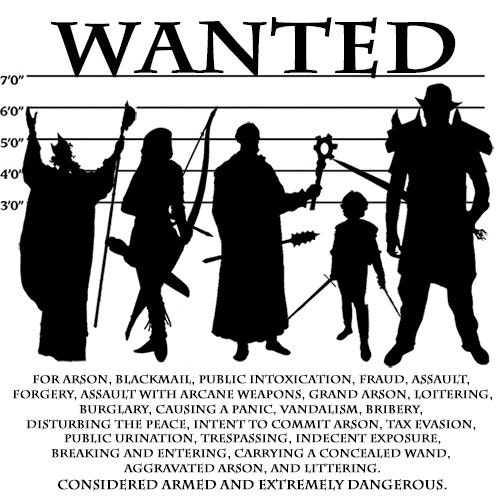
Especially arson...there's always arson...

However, there are a few twists that I get a kick out of.

Friday, August 11, 2017

Report on the so-called "sick rock" mineral

Let me start with a little background about my weekly campaign.  As I've mentioned before, I'm running my adaptation of Anomalous Subsurface Environment, the great OSR megadungeon affectionately known as "ASE."  The best part of it is that my players haven't set foot in so much as the gatehouse, as they are continually deflected from their quest by their own misadventures.


Just another day in ASE

That quest is to retrieve a certain quantity of raw protonium ore for their patron, an old and clever dragon.  They know that they can find this in a place called Mount Rendon, and to gain entrance to this mountain they must obtain a small quantity of what is known as "sick rock" i.e. uranium.

Towards the end of a fun little picaresque journey from their portal to Denethix, the party got its hands on this very material in the traditional way (i.e. they beat-up some lion men).  ASE provides a nice little lair dungeon to make this happen, so I ran that and the PCs won the prize.

But then they lost it.  It wasn't really their fault.  Well, actually, they sort of panicked and let it be known that they had found the wizard's lost sick rock. After being thanked and rewarded, the authorities took custody of the stuff and sent the PCs on their way.  So now what?

Wednesday, July 12, 2017

Empress - magic rules, revised

Hey gang!  One of the things I've been doing lately has been tweaking the Empress rules for spell casting.  I didn't change that much, but here's a list of what was added:

  • There are now only five spell levels.
  • Casting spells now have a price, which is equal to four times the spell level minus the caster level, with a minimum value of twice the spell level.
  • The price of a spell is proportional to the cost paid by the magician.  As before, the exact nature of the cost depends on the type of magician - time for sorcerers, physical energy for mystics.
  • The precise costs of spells has been tightened up.
  • Any spell parameters that scale, like duration, damage or range, scale based on the caster's level plus the appropriate ability modifier (Spirit for mystics, Mind for sorcerers).
  • There's a spell list!  This is the biggest change; rather than leaning on the SRD or the Lamentations list, I decided to write my own from scratch.  It really wasn't too hard, since I resolved to keep the descriptions short and sweet.

One thing you may notice about my spell list is that few of them have combat applications.  My conception of magicians is that they are not medieval superheroes, firing beams out of their fingers and flying around like a robed Captain Marvel.  Using magic in combat should be quite possible, but it should be indirect and require some creativity.  When it comes to giving and taking damage, fighters should be kings of the battlefield at all levels.

Summon Answer!

Magicians occupy a strange position in many parties.  It's clear that fighters should have a front line combat role.  Thieves are well-suited to all those non-combat adventuring activities.  But magic-users, in the traditional model, are basically able to do pretty much anything, but only a limited number of times. With a traditional magic-user, you can become a combat powerhouse (with your Fireballs and your Cloudkills), or the perfect burglar (with Invisibility and Knock).  It just doesn't seem fair to the other classes to have magic-users occasionally outshining them in their own specialties. 

So I try to find other things for magicians to do.  And I partly succeed.  But you're never going to have a magic system without an Invisibility spell.

Without further ado...

Tuesday, July 11, 2017

The Curse of Stupidity

I've seen a number of OSR blogs (rightly) complain of the utterly boring nature of D&D magic weapons.  Plenty of posts have been made offering (welcome) replacements for the tired-as-fuck sword +1.  Doot-dee-doo, OSR to the rescue!

So tired of these


But you know what's dumber than a +1 sword?  A fucking -1 sword.

Saturday, May 20, 2017

Blackrock!

I'll keep this post brief: I decided to change the name of my adventure setting, as well as the product as a whole.  They are one in the same: Blackrock!

My thousands of loyal readers may recall that Blackrock is the name of a suburb of Punjar in my monthly DCC campaign.  But I came up with that, so I feel justified in repurposing the name.  Not only that, but "Blackrock" is such a perfect name for this project.

A hot commodity?

For one reason, it's thematically appropriate, because the town was once the site of a human basalt mining settlement that was enslaved to giantfolk.  And since I'm now thinking beyond the bounds of the singular heist, calling it "The Cursed Sword" or "The Vault of Blades" just didn't seem appropriate anymore.  In light of that, "Blackrock" is a much better title for the project than "Hoblington."

That's all for now.  I'm still mulling over a candidate for review (there are so many...the addiction continues).

Thursday, May 18, 2017

Learning to crawl

I've always loved GMing.  When I was a kid in high school, I was enamored with the prospect of inventing my own imaginative and immersive worlds, and using them to fill my players with wonder.  These days, the emphasis has moved away from the idea of showing off my creativity, and towards a fascination with engaging my players.


There's a certain egotism to the practice of GMing

That isn't to say that I've entirely given up trying to come up with cool stuff. For instance, that DCC adventure I've been working on.  Well, one thing led to another, and the idea has snowballed into something a bit larger.  That doesn't sound good, does it?  An excess of ambition can kill a hobbyist project faster than anything.

Monday, May 1, 2017

For the last player to arrive at the table

Roll the accent with which you must speak for the amount of time you were late
  1. Woody Allen
  2. Foghorn Leghorn
  3. Deliverance redneck
  4. Queens, baby
  5. Millennial up-talker with vocal fry
  6. Hardcore Minnesotan
  7. Steve Irwin (everything is gorgeous)
  8. Prohibition gangster (see here...)
  9. Sly Stallone
  10. Werner Herzog
  11. Shatner
  12. The Macho Man
Be warned: with the wrong group of players, this will encourage lateness.

Tuesday, March 14, 2017

Spells without levels

The title of this post reflects a recent design ambition of mine, which is to eliminate spell levels from OSR games without eliminating spells.  I have a few reasons for this.  First, as I've been recently discussing, I have an interest in sandbox play without character progression, and having spell levels starts to feel overly restrictive when characters don't even have levels.

Another thing I've noticed, however, is that the nature of spells and spell levels in OSR makes it difficult for such games to support multi-classing.  At first glance, it may sound like I'm talking about very unrelated things, so I'll explain a little more.  


Don't make me choose, OSR!


Sunday, March 12, 2017

Concepts in sandbox play

So, in continuance of some of my earlier thoughts about sandbox play and how it relates to character progression, I've been slowly coming up with ideas for a very simple tabletop FRPG that is based on the idea of little-to-no appreciable improvement from "experience."  Let me discuss some of my initial thoughts.

Strategic advantages

One advantage of having a game like that with very human-scale characters is that you can take advantage of certain assumptions to simplify the game mechanics.  For instance, I don't have to worry about things being highly scalable.  Everything can be muted down to a similar level of power, where special abilities allow you to specialize, but don't end up abusing verisimilitude and game balance in the long term.

This means I don't have to provide really big ranges for power levels.  Things don't have to be super-granular.  This immediately calls a certain mechanic to my mind, one which I have enjoyed greatly in practice: the skill system for Lamentations of the Flame Princess.  What occurs to me is that, lacking character progression, character abilities and character skills can be much the same thing.

Wait, that's not how reflections work...

Friday, February 17, 2017

An idea for the sandbox: no character progression

Sometimes, we are so used to traditions and convention that we forget to question them.  One that I've been re-considering lately, for the first time ever, is the idea of character progression.  I only know of one RPG where improvement of skill over time was not assumed to happen: classic Traveller

This was the rulebook I had back in the day

With that one exception in mind, I can't think of any tabletop RPG that doesn't have a system for character progress.  The main question that most rules answer is whether to have a class-and-level system, or track individual skill levels.  Games carefully consider what is the proper rate of character improvement.

But is this all absolutely necessary?