As I mentioned in another post, one of the little projects that I'm working on is to design a Super Scientist class for DCC. My objective here is twofold. First, I want the class to play very differently from all the base DCC classes, to not merely be a Wizard re-skinned with gonzo science-fiction trappings. That sort of thing is lazy, and represents an excessive blurring of lines between literary magic and literary science.
My other objective may seem to be at odds with my first: I want the Super Scientist class to be "arcane" enough that it could easily be a stand-in for a more fantasy-oriented magician like an alchemist, or something even less defined. It is enough that one called "wizard" has access to weird powers and strange trinkets. We want to find a place between magic and science fiction, whereas the DCC Wizard is (mechanically) firmly rooted in fantasy.
There are a lot of settings and concepts that could accommodate the class, as I envision it. Consider the bizarre "wizards" of The Land of One Thousand Towers, in Patrick Wetmore's Anomalous Subsurface Environment. These power-mad tyrants each control fragments of a ancient technologies, technologies so advanced as to accomplish wondrous things. One has learned how to produce armies of obedient dog-men, while another is able to build powerful firearms that bind their wielders to his will and gets around in a giant flying metal head the shoots lasers from its eyes (of course).
There are examples closer to home, like the Venture Bros., Hannibal from the A-Team and even that 80's TV classic, MacGuyver. The point is that we can conceive of this class as something that straddles the divide between art and science. The Super Scientist is able to do extraordinary things, and the outcome of his endeavors is always affected by chance.
How, then, is the Super Scientist different from the standard DCC Wizard?
Wednesday, November 23, 2016

Wednesday, November 9, 2016
An RPG review: Crypts and Things Remastered
It's been a while since I've posted anything here; that's mainly because I'm still working on some new content (the DCC adventure I mentioned in an earlier post, as well as a completely novel DCC class...more on this another time). I've also absorbed even more tabletop RPG content. It's really getting out of hand.
Anyway, I've been running out of DCC materials that catch my attention, and I promised Stan that I wouldn't look too closely at Purple Sorcerer Games - this because he's thinking of running one of their DCC adventures! But there's still plenty of other stuff, and I can't really help myself.
Just the other day I was re-reading the excellent The Black Hack. I am intrigued by an OSR game that requires players to make all the dice rolls. Attacking? Roll to hit. Being attacked? Roll to avoid. TBH also introduces a unique mechanic to simplify and abstract bookkeeping for supplies: resource dice. Quantities of identical items are roughly measured by a die of a certain size (d20 for "a lot," d12 for "a bunch," and so-on until d4). When a character uses one of these items, roll the resource die - on a 1-2, drop the die size by one (e.g. a d12 becomes a d10). If the resource die was a d4, rolling 1-2 means that it's depleted.
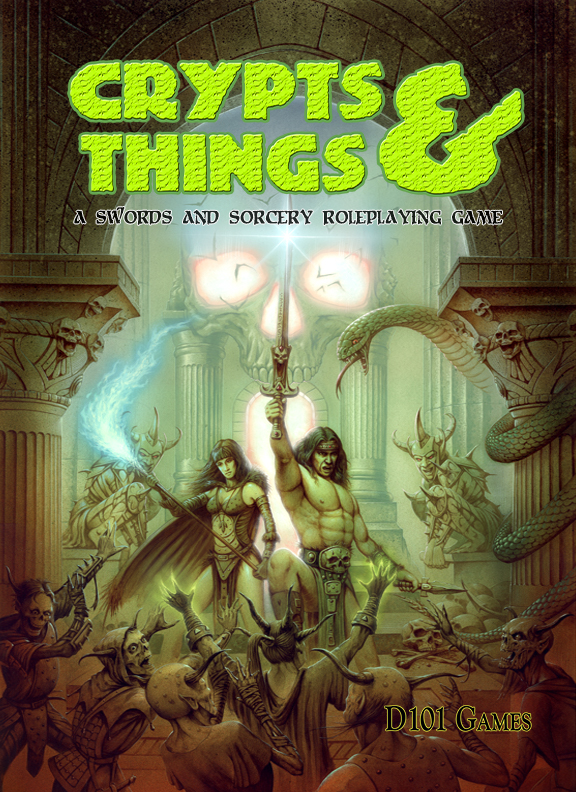
Anyway, something I picked up recently was the very intriguing Crypts and Things Remastered. Written by Newt Newport and published by d101 Games, available on DriveThruRPG in hardcover, softcover and PDF forms. Like TBH, it's a (relatively) simple OSR game with a number of unique mechanics. The rules are tightly bound to the setting, which is a very specific swords-and-sorcery world that draws heavily from Appendix N literature.
So let's get into some specifics. What's to love about C&T?
Anyway, I've been running out of DCC materials that catch my attention, and I promised Stan that I wouldn't look too closely at Purple Sorcerer Games - this because he's thinking of running one of their DCC adventures! But there's still plenty of other stuff, and I can't really help myself.
Just the other day I was re-reading the excellent The Black Hack. I am intrigued by an OSR game that requires players to make all the dice rolls. Attacking? Roll to hit. Being attacked? Roll to avoid. TBH also introduces a unique mechanic to simplify and abstract bookkeeping for supplies: resource dice. Quantities of identical items are roughly measured by a die of a certain size (d20 for "a lot," d12 for "a bunch," and so-on until d4). When a character uses one of these items, roll the resource die - on a 1-2, drop the die size by one (e.g. a d12 becomes a d10). If the resource die was a d4, rolling 1-2 means that it's depleted.
Anyway, something I picked up recently was the very intriguing Crypts and Things Remastered. Written by Newt Newport and published by d101 Games, available on DriveThruRPG in hardcover, softcover and PDF forms. Like TBH, it's a (relatively) simple OSR game with a number of unique mechanics. The rules are tightly bound to the setting, which is a very specific swords-and-sorcery world that draws heavily from Appendix N literature.
 |
| See, I'm getting better at this! |
So let's get into some specifics. What's to love about C&T?
Wednesday, October 26, 2016
Irresponsible acquisitions!
This is going to be a short post. I wanted to mention that I've picked up a few DCC adventures since Journey to the Center of Aereth. There's been a lot of intriguing materials lately, much of it from DCC publishers Goodman Games.
Let's see what I got...
Saturday, October 22, 2016
DCC session report - Blackrock Brothel #2
When last we left our heroes...
In this session of the Blackrock Brothel campaign, we return to our intrepid adventurers as they have reached the bottom of the wizard Nekros' subterranean sanctum, a bizarre scene: at the bottom of a gaping two-mile deep shaft, reached after two days of marching down an interminable staircase, there lies a lake of acid, inhabited by colossal leeches, spanned by a set of narrow circular bridges. At the central convergence of these bridges there waits a gigantic mound of guano. This is the home of a wizard, and clearly, the ways of wizards are not the ways of ordinary men.
For this session, the following players were in attendance:
- Stan, in charge of Grognard the Dwarf and Courve the Thief
- Xavier, running with the priest Dar Shasta and Archimedia the Thief
- Steve W., stepping in for Brendan to manage Sizarius the Wizard, and the mighty warrior Greg
In the real world, our session was delayed by about an hour due to connectivity issues, and the need to bring Steve up to speed. I was worried that this would leave us without enough time to stab things and generally dampen spirits, but once the action got started, my fears were proven groundless.
Tuesday, October 18, 2016
Sine Nomine and the sandbox
I talk a lot about DCC here, mainly because DCC is what I'm actually running right now. And I'm running it because it's currently my favorite RPG; I'll probably explain that in another post. But that doesn't mean it's the only RPG that I enjoy. In fact, my interests aren't limited to OSR: for instance, now-venerable Over the Edge is my second-favorite RPG.
But OSR is definitely what has my attention these days, and that's what this blog is about. In this post, I just wanted to say a few words of appreciation for Kevin Crawford's amazing work published by (his one-man operation) Sine Nomine. I was reminded of this guy when I read through his latest work for Godbound, an adventure called Ten Buried Blades. By the way, it's excellent.
Sine Nomine has been pumping out utterly fantastic sandbox content for an assortment of settings, always expressed through simple OSR mechanics. These settings are always terrific, and his variations on the OD&D ruleset are always clever adaptations to these settings. But the real genius of Sine Nomine products is that they provide frameworks for the GM to create his or her own content in these settings. By frameworks, I mostly mean a ton of well-designed tables chock full of inspiration and plot hooks.
Great stuff! You may be wondering if I've ever actually run this stuff. And the answer is: no, because I don't feel ready, yet.
But OSR is definitely what has my attention these days, and that's what this blog is about. In this post, I just wanted to say a few words of appreciation for Kevin Crawford's amazing work published by (his one-man operation) Sine Nomine. I was reminded of this guy when I read through his latest work for Godbound, an adventure called Ten Buried Blades. By the way, it's excellent.
Sine Nomine has been pumping out utterly fantastic sandbox content for an assortment of settings, always expressed through simple OSR mechanics. These settings are always terrific, and his variations on the OD&D ruleset are always clever adaptations to these settings. But the real genius of Sine Nomine products is that they provide frameworks for the GM to create his or her own content in these settings. By frameworks, I mostly mean a ton of well-designed tables chock full of inspiration and plot hooks.
Great stuff! You may be wondering if I've ever actually run this stuff. And the answer is: no, because I don't feel ready, yet.
Monday, October 17, 2016
Great DCC resource from Purple Sorcerer
I just discovered the online DCC resources from Purple Sorcerer, and I'm in love. The have generators and dice-rollers galore, but the real star of the show is something called the Crawler's Companion. This app (web, desktop and mobile versions available) manages to compress all the mechanics and resources of the core rules into a single piece of user-friendly software.
This is an extremely impressive feat. The amount of reference materials here are amazing...basically, every detail of all the spells in the core rules are available. When I say this is comprehensive, I'm talking about built-in tools for generating magic swords and demons. And with all of these reference materials available, Crawler's Companion can roll the dice for you.
This is an extremely impressive feat. The amount of reference materials here are amazing...basically, every detail of all the spells in the core rules are available. When I say this is comprehensive, I'm talking about built-in tools for generating magic swords and demons. And with all of these reference materials available, Crawler's Companion can roll the dice for you.
Sunday, October 16, 2016
Writing a DCC adventure
My previous campaign was using my Empress rules, and I was going for something relatively low-magic, or at least a setting where magic is subtle. I was going for something a little grittier and low-key, with plenty of intensity but not much flash. That way, I reasoned, it would be all the more exciting and mysterious when characters encounter the supernatural.
Well, I've largely abandoned that approach, for now, and instead embraced the gonzo ethos of Dungeon Crawl Classics. That doesn't mean I'll never return to a more low-key approach, but I've come to believe that getting players to engage with that kind of material requires a better GM than I am - at least, at this time. I've taken a step back from trying to create everything from scratch, and taking my cues from something undeniably successful.
That said, I haven't given up entirely on creating my own content. Towards the end of my run with Empress, I had a number of ideas for an adventure, and I think there were some very strong concepts in there. Long story short - it didn't quite work, in practice. But I still think there were some great core ideas that I'm not ready to give up on.
So now I'm trying to take what I've learned from DCC, and incorporate it into a new treatment of this adventure. I'm going to talk about some of my ideas, here, and in future blog posts, I'll probably release bits and pieces of content.
Be warned: if you're one of my players, there will be a lot of spoilers to be found. You'll ruin some of the fun if you read these posts, so I'll be sure to keep any such material "below the fold."
With that in mind...
Well, I've largely abandoned that approach, for now, and instead embraced the gonzo ethos of Dungeon Crawl Classics. That doesn't mean I'll never return to a more low-key approach, but I've come to believe that getting players to engage with that kind of material requires a better GM than I am - at least, at this time. I've taken a step back from trying to create everything from scratch, and taking my cues from something undeniably successful.
That said, I haven't given up entirely on creating my own content. Towards the end of my run with Empress, I had a number of ideas for an adventure, and I think there were some very strong concepts in there. Long story short - it didn't quite work, in practice. But I still think there were some great core ideas that I'm not ready to give up on.
So now I'm trying to take what I've learned from DCC, and incorporate it into a new treatment of this adventure. I'm going to talk about some of my ideas, here, and in future blog posts, I'll probably release bits and pieces of content.
Be warned: if you're one of my players, there will be a lot of spoilers to be found. You'll ruin some of the fun if you read these posts, so I'll be sure to keep any such material "below the fold."
With that in mind...
Subscribe to:
Posts (Atom)