Sunday, October 22, 2023

Restating the OSR

Loyal readers, I've been involved in various online discussions over the last month about what the OSR actually is. Surely, this is a novel topic which has never been discussed before, as opposed to being a subject for never-ending reexamination. Never let anyone tell you that tabletop role-gamers are mere navel-gazing sophists!

Yes, well. In all seriousness, I've seen one particular bubble of discontent that has been recurring of recent; not quite a froth, but a zesty effervescence, if you will. And I think good points are being made. It is best summarized thusly: the founding principles of the OSR are wildly overstated.

This strikes me as humorous argument because the backlash against this overstatement is itself often overstated. But there is some truth to this contention. Let's look at those foundational principles, the history that motivated them, and see if we can reframe the OSR from a fresh perspective.

Nerd fight!

History of the OSR

Forgive me, but I'm going to gloss over a lot of nerd history here. Anyway, the story goes something like this:

The third edition of D&D came out in 2000. Immediate discontent materialized within the grognardarium. This was no longer D&D, and something was lost. The old-schoolers went underground for a while, maintaining their ancient traditions in hidden corners like Dragonsfoot. Eventually, they boiled forth from the Underdark with a new banner: OSR.

Who coined the term? My understanding is that it was first used formally in the promotional materials for the first issue of Fight On!, but this may have in turn evolved out of Matthew Finch's famous tract Quick Primer for Old School Gaming. Indeed, many of the edicts which we will soon discuss come directly from this work.

To summarize: the OSR appeared as a reaction to and against post-second edition D&D. The fourth edition probably only strengthened the movement. I'm not even going to begin to talk about the (still ongoing) relationship between the OSR and fifth edition.

The Principles

Better settle in...

I'll be relying on two works which had a lot of influence in establishing the culture of the OSR: the aforementioned Quick Primer for Old School Gaming, and the equally-beloved Principia Apocrypha.

Here are the edicts from the Primer, aka the four "Zen Moments":

    • Rulings, not Rules
    • Player Skill, not Character Abilities
    • Heroic, not Superhero
    • Forget “Game Balance”

And from the considerably more long-winded Principia:

  • Be an Impartial Arbiter
    • Rulings Over Rules
    • Divest Yourself Of Their Fate
    • Leave Preparation Flexible
    • Build Responsive Situations
    • Embrace Chaos...
    • ...But Uphold Logic
    • Let Them Off The Rails
  • Get Them Thinking
    • XP For Discovery & Adversity
    • Player Ingenuity Over Character Capability
    • Cleverness Rewarded, Not Thwarted
    • Ask Them How They Do It
    • Let Them Manipulate The World
    • Good Items Are Unique Tools
    • Don't Mind The Fourth Wall
  • Build Rocks & Hard Places
    • Offer Tough Choices
    • Subvert Their Expectations
    • Build Challenges With Multiple Answers...
    • ...And Challenges With No Answer
  • Dice With Death
    • Deadly But Avoidable Combat
    • Keep Up The Pressure
    • Let The Dice Kill Them...
    • ...But Telegraph Lethality
  • Be Their World
    • Reveal The Situation
    • Give Them Layers To Peel
    • Don't Bury The Lead (sic)
    • Keep The World Alive
    • NPC's Aren't Scripts
  • Old School Principles for Players
    • Learn When To Run
    • Combat As War, Not Sport
    • Don't Be Limited By Your Character Sheet
    • Live Your Backstory
    • Power Is Earned, Heroism Proven
    • Scrutinize The World, Interrogate The Fiction
    • The Only Dead End Is Death
    • Play To Win, Savor Loss

My God, Principia, you had a lot to say!

What's Wrong With This?

Well, it's actually true

I'm not going to go over these point-by-point. Instead, I'm going to point out a few places where literal interpretation lends itself to absurdity. Although the Principia is much longer, it spiritually intersects with the Primer at so many points that it's just easier to address the latter.

Rulings, not Rules

If that's so grand, why have rules at all? Indeed, extremists of this approach advocate for free kriegsspiel; follow the link if you're curious. But is this OSR? Certainly not the way most people play it!

There is even pushback within the OSR against rules-lite RPGs. The common objection is that a minimalist set of mechanics lend themselves to an arbitrary system of resolution, making it hard for players to guess their chances of success to a degree that is actually unrealistic. I think some counterarguments can be made: no system can ever be truly complete, and a good GM will make consistent rulings that evolve into rules.

But then one may argue that rulings become rules, and over time, rulings will become increasingly uncommon. That's not a very anti-rules-pro-rulings stance, now is it?

Player Skill, not Character Abilities

Oh really? So what does it mean if my character is a wizard? That I should solve every problem with a ten-foot pole and a bit of lamp oil?

This gets even more unlikely as characters become more competent and powerful. A good player should make use of all their character's resources, and that includes their abilities.

Forget “Game Balance”

Um, should we actually "forget" game balance? Just spring red dragons on our first-level party? That's nobody's idea of fun. There's a reason that 1e had level-based encounter tables, and it wasn't to "forget" about game balance. Sure, the party can run into a dragon in the wilderness, but a good and reasonable GM is going to give the players a chance to scamper behind some rocks, negotiate for their lives, or even find the dragon in a particularly good mood.

And so on!

Putting it into Perspective

We're all just figuring this out on the fly

Let's return to our history lesson for a moment. Remember that the OSR was a reaction against third edition D&D. All these edicts need to be understood in light of that. They are a corrective...arguably an over-corrective.

That's all fine and dandy, but increasingly I run into newer players online who have better things to do than brush up on the history of old nerds. They are justly confused by some of these principles because they lack the context.

The truth is that the OSR has outgrown its origins. It still persists because it is a legitimate and wonderful way to role-play, and it represents a distinct style that is not entirely widespread. Fifth edition has its many missteps, but they are not the same ones that the OSR was concocted to correct.

So let's restate some of these edicts to function as standalone principles for the movement.

The New Constitution of the OSR

I bet they argued like crazy, too

I'm going to take a page from Finch and keep it down to a mere five amendments, although each one has a clarifying corollary. Discuss! Debate! Enjoy!

I. RPGs are played as games of adventure and exploration.

Corollary: This often includes elements of combat, negotiation, investigation, and general problem solving.

II. The GM sets the scene, the players make the decisions, and the dice determine the outcome.

Corollary: Player agency is absolutely vital, but no single participant (i.e. GM, players, dice) controls the outcome.

III. Resource management is an important part of the game.

Corollary: Resources include equipment, time, wealth, social standing, and physical and mental states of characters.

IV. Adventures should be designed such that success is well-possible with good decision-making.

Corollary: Good or bad fortune may change the expected outcome depending on what players leave to chance.

V. The GM must either rely on the rules or good and consistent rulings that do not bias a desired conclusion.

Corollary: The mechanics of these rules and rulings must be followed as faithfully and transparently as possible.


Saturday, October 21, 2023

Been playing a lot of OSE

It's been a minute! In the meantime, I've still been gaming and creating, so maybe we should catch up a little bit.

Do you feel the same? Aw!

System of Choice

For the past couple of years, I've focused a lot of my creative efforts on OSE. Why is that, one might ask? I won't claim that it's some kind of perfect system, but there are a few things that I really like about it:

  • The rules are comprehensive. No, it doesn't cover everything, but no system ever could. But it has solid and simple rules for wilderness and dungeon adventuring, henchmen and retainers, etc. These are easily-grasped and time-tested.
  • I'm particularly a fan of OSE Advanced Fantasy. I think it represents a great adaptation of 1e content into a B/X framework. Frankly, I think too many mechanics of 1e are unnecessarily complex and obtuse (I'm looking at you, unarmed combat). I have no particular love for psionics, which I think can simply be adapted as another kind of magic if you really want something with that flavor. But all the monsters, classes and magic items? Yes, please.
  • The B/X framework is easily house-ruled as one sees fit. I have plenty for my own table; I'll even mention a few below.
  • The main selling point of D&D-based OSR systems is their mutual compatibility. This allows you to draw upon decades of fantastic content for your own table. There's nothing particularly attractive to me about the pre-third-edition D&D rules (nor is there anything special about third and beyond; quite the contrary). B/X lies at the core of the compatibility matrix. And (in case you are somehow unaware), OSE is just B/X with a shiny coat of paint.

Also, it's got the coolest art

Magnum Opii

With my own gaming group, we've played plenty of non-D&D games: WFRP 4e, Paranoia with WaRP mechanics, Call of Cthulhu, Mothership, Stars Without Number, etc. But the content I've been creating has all been OSE-based.

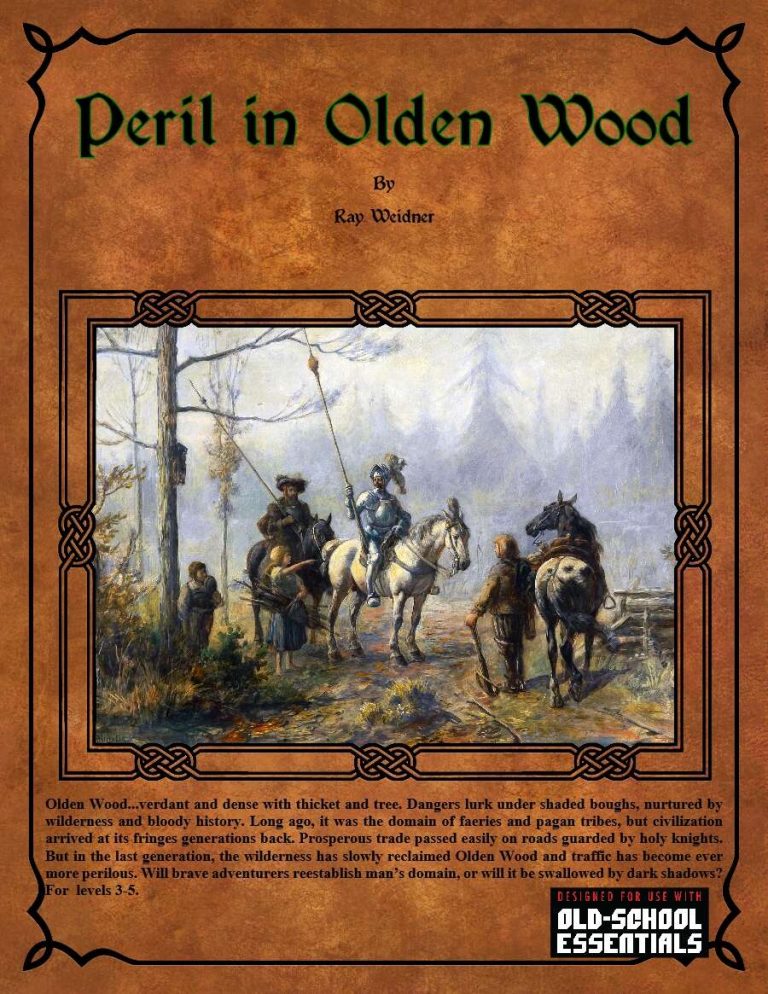
My greatest work so far has been Peril in Olden Wood. That adventure received praise from some of the stalwarts of the OSR scene (Bryce and Prince of Nothing were very generous with their words), and I had a blast playtesting it with my weekly troupe. It's low-to-mid-level D&D that relies almost exclusively on official monsters, spells and magic items. Prince of Nothing's ongoing No-Artpunk Contest inspired me to create something with these design constraints, and I found it to be a wonderful exercise.


Many laurels ensued

In fact, I'm participating in the upcoming NAP III contest! The adventure I'm submitting will be called Death-Maze of the Sorcerer Kings, and it is similarly reliant on "book" content. Whereas Peril has a vibe that's gritty, fey and rural, Death-Maze is gonzo, urban and swords-and-sorcery. One reason for this is that NAP III introduces a new constraint: the adventure must be high-level. So the only option was to turn the dial up to eleven!

But that's only the beginning! I'm partnering again with the inestimable Merciless Merchants and its god-emperor Malrex to create an adventure which will vastly expand upon Death-Maze of the Sorcerer Kings. Tentative title: Beware the King of the Cannibal Cult!

What's in the box?

So what's Death-Maze going to be like? I could say "you'll see," but that would be an abrupt end to the topic. So I'll kibbitz a little.

The premise is that the party has been invited to represent one of the Sorcerer Kings of the decrepit Narzid Empire in the Contest of Selection; this is how they pick their Overlord for the next dozen years. The previous Overlord creates a perilous dungeon, and the other Sorcerer Kings sponsor bands of adventurers who race to exit it before any of the others; i.e.  the titular Death-Maze.

But even before entering the competition, the party arrives in the decadent city of Eren-Krarth, wherein they are met by various intrigues, risks and rewards. There are even opportunities to gain advantages in the ensuing Contest, not to mention the possibility of eliminating the competition before it even begins. Or to be eliminated prematurely.

Of course, the devil is in the details. I won't try to summarize exactly how all of this is rendered, mainly because I might as well just post the adventure itself. But I'll mention some of the content you can expect to encounter in Death-Maze:

  • Red Dragon
  • Portable Hole
  • Beholder
  • Staff of Wizardry
  • Mind Flayers
  • Efreeti
  • Sphere of Annihilation
  • Sixteen-Headed Hydra
  • Obligatory Thieves' Guild (actually a crime family)
  • etc.

I even manage to throw in a smattering of science-fantasy. Just a sprinkle.


This is what Midjourney gave me for a Mind Flayer, but I kind of like it anyway

What about Beware? Well, like I said, it's a lot bigger, so I manage to cram in quite a bit more, like:

  • Lich
  • Evil Cults Aplenty!
  • Demigods
  • The Wand of Orcus
  • Wyvern
  • Two Purple Worms (one undead)
  • Vampires
  • etc.

There's a bit more original content in Beware!, but it's still pretty restrained. I'll let all of that be a surprise. In terms of plot, there's significantly more intrigue in Beware!, mainly because the party is requested by a bishop of the True Faith to find the stolen Wand of Orcus before something bad happens.

Oh Yeah...Some House-Rules

I did say that I was going to post some of my OSE house-rules, didn't I? Let me cherry-pick some of the ones I like the most:

Two-Weapon Combat

The character has the choice of using the secondary weapon to parry or to attack, and this choice is made during action declaration. If they are not attacking at all, it is treated as being used to parry.

A secondary weapon used to parry provides an AC bonus of +1 against a single attack directed at the character during the round. This may not be used against ranged attacks.

A secondary weapon used to attack allows the character to roll damage for both weapons if a hit is scored, keeping the higher roll.

Arcane Magic

Casting Spells

A spell can be cast in a number of hours equal to its level. To cast a spell, the arcane spellcaster must either have it memorized or have their personal spellbook present.

Storing Spells

Spells may be stored in special items called talismans. A talisman is any hard object in which the arcane spellcaster has carved their personal glyphs. To prepare a talisman takes one day per glyph, and a glyph takes up one square inch of the surface area.

A talisman may hold a number of spell levels equal to the number of glyphs that are carved into it. Only the arcane spellcaster who created a talisman may store spells in, and later trigger them.

A spell is stored by casting it into the talisman. To trigger the spell, the caster must be in physical contact with the talisman, and speak the names of the glyphs used to store it while focusing his entire attention. In combat, this takes an entire action.

An arcane spellcaster may only store a number of spells of levels as given by their spell slots. They cannot prepare more glyphs than would equal the sum of all spell levels they can store. An arcane caster may spread these over multiple talismans.

Thief Skills

Thief skills kind of suck in B/X. The chance of success is just way too low at low levels. I far prefer the system used by Lamentations of the Flame Princess. It's super-simple and balanced without completely nerfing low-level thief skills. Thieves (specialists, in that system) have the opportunity to, well, specialize in the skills they choose. The system uses a D6 instead of D100, and the thief can allocate skill points every level to whichever skills they want.

Enough For Now

Anyway, hopefully that catches us up, mostly. I'll try to post something else soon. I've been thinking a lot about how to make clerics better. In short, I don't like how all clerics in OSR D&D are Judeo-Christian themed (even evil clerics!), and I don't like how their magic works so similarly to that of arcane spell-casters.  More later!


Monday, February 15, 2021

Simplifying combat: damage for dummies

Remember how I was saying that combat is boring, and we should get rid of initiative? That was a pretty cool idea, right? You see, this obsession with making combat as simple as possible is not new for me, but it received new life when a role-playing friend of mine asked how I could make combat as simple as possible without losing too much.

What could be simpler than a good smack to the mouth?

Of course, your definition of "too much" is as subjective as mine. But this friend shares certain sensibilities, or at least he understands mine. Since we're both software engineers, we're quick to see the advantage of making any calculation as simple as possible. Indeed, all good programmers are a certain kind of lazy.

(Humorous irony: The person who wrote the article I linked to above just so happens to play Pathfinder. Not exactly a paragon of simplicity in mechanics, is it?)

There's something about Pathfinder art that I find exhausting

Anyway, I'm getting off-topic. My apologies. Let's get back on track. Today's goal is to get rid of hit points and rolling for damage. Can we combine hitting and damaging into one simple roll? Well, yes, but that's been done before. We're also going to pare damage tracking down to the bone.

Saturday, February 6, 2021

Another kind of magic

I've already mentioned that I think too much about different ways of doing fantasy magic, so it should be no surprise that I'm at it again. Why do I enjoy doing this? Well, the idea of magic is so malleable, and ultimately, it's a literary concept, since it doesn't apply to anything real.  I'd argue that, by definition, magic is unreal.

Thus, the act of defining "magic" and even daring to tie it down with game mechanics is both seductive and frustrating. Seductive, because that which is innately mysterious is bound to attract curiosity, but frustrating because understanding is ultimately elusive.

Anyway, today's take on magic is to replace all those spells and magic items in traditional RPG fantasy with two tools: potions and scrolls.

That's the stuff

Sunday, January 31, 2021

Simplifying Combat: dropping the initiative roll

Hey, isn't combat boring?

Wait, what? You thought combat was what role-playing was all about? No, I believe you're thinking about war-gaming. Role-playing is a distinct type of gaming, arguably not-a-game — among it's many odd features, two that stick out for me are the fact that (1) the rules are almost secondary, and (2) "winning," per se, isn't terribly important or even necessarily possible.

In that context, how are we expected to revel in combat? Some people enjoy very detailed simulationist mechanics, and in those games, players are likely thinking deeply about minimaxing their characters, comboing their abilities and optimizing their team synergy. That's fine and good, but I'd say even if you were ostensibly role-playing when you started doing that, you've temporarily segued into wargaming. Just not my style, I'm afraid.

Preach on, brother

What don't I like about role-playing combat? Well, first of all, it's slow. When a minute ago you might have been narrating over days at a time, in combat, you often find yourself spending an hour of realtime in correspondence with thirty-seconds of gametime. That ruins the pacing of an otherwise breezy session.

Second, it feels like a different kind of activity. This is a product of the wargaming aspect, and the way that combat slows things down. When a character wants to pick a lock, you talk it out, state a difficulty, roll and move on. Not so with combat. Instead, everyone is acting in a highly regimented order, and the conversational flow of the action is lost.

Personally, I'd love to get rid of the combat round, and replace it with something more free-flowing. For all the criticisms lobbed their way, this is something the World games (Apocalypse World, Dungeon World, etc.) accomplish quite nicely. The game conversation flows in exactly the same way, with players taking turns, round robin, to say what they are doing, and the GM responding in turn.

I'm not quite ready to go that far, however. But I do think we can do away with initiative.

Encounter ranges in old D&D

Before I go any further, I want to mention something about the title of this article. My term "old D&D" is an attempt at a coinage — basically, everything from so-called 0e through 2e, and any retroclones derived therefrom. If there's already a term for this (OSR seems a bit more expansive), then please let me know.

Anyway, the subject of this article is something I call encounter ranges. This is basically a replacement for the mechanics of surprise. The end result is fairly similar, but it broadens and sharpens our concept, all at the same time.

Surprise!


Saturday, January 2, 2021

A concept of magic

I'm always tinkering with rules and underlying concepts for "magic." Anyone who spends (too) much time working on these kinds of things starts to ask fundamental questions about imaginary concepts, which is obviously a strange undertaking. And this leads us to the perennial question of fantasy literature and gaming: what is magic?

I'm not going to try to answer that here, for a couple reasons. First, it's a subtle and complex concept, and I don't know if I want to go into that much detail in this place and time. But more importantly, it's a very wanky thing to do. So we'll save it for another time.

Instead, I'm going to talk about some ideas I had for a magic system. This was initially conceived for a Delta Green-like modern horror-fantasy campaign, but I think it can be easily adapted to an old-school swords-and-sorcery setting just as well. All we'd need to do is change a little of the window dressing.

I like my magic like I like my coffee—black